

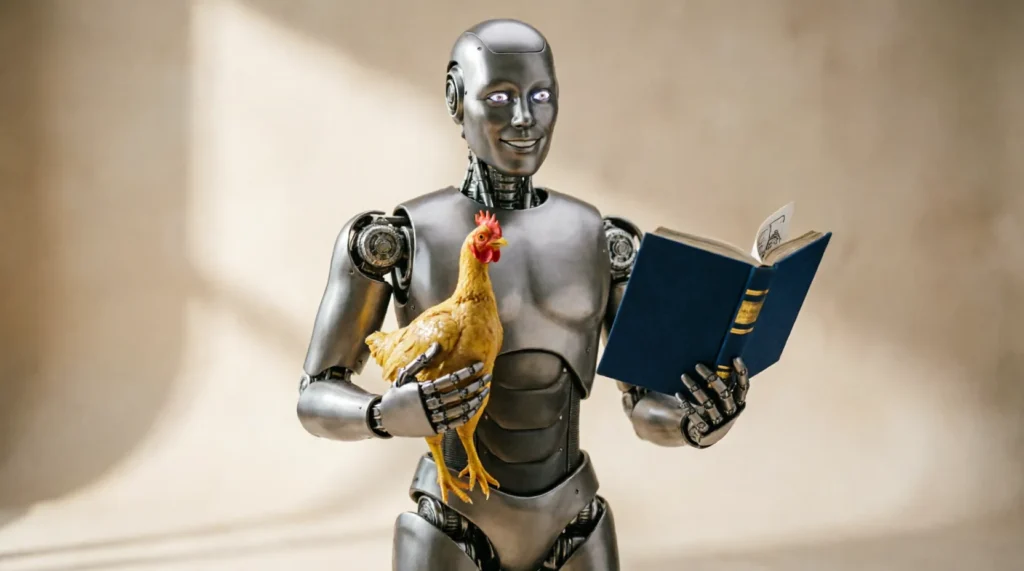
Artificial intelligence can write code and diagnose diseases, but when you ask it to be funny, the results often feel like a robot reading a dictionary aloud. The truth is that AI is technically proficient at puns because they are mathematical word associations, yet it frequently misses the cultural timing that makes a human audience actually laugh.
If you’re curious what it actually costs to run these models at scale, the OpenAI pricing calculator breaks down the token economics behind the jokes.
Top 10 AI Puns
- My neural network is feeling a bit dense today— This one works best as a self-deprecating caption for tech professionals on LinkedIn; the double meaning of “dense” (stupid vs. data-heavy) bridges the gap between jargon and relatable burnout.
- I tried to explain humor to my chatbot, but it just didn’t compute— A classic groaner that lands perfectly in a newsletter subject line or a blog header about AI limitations; the phrase “didn’t compute” is retro enough to signal intentional cheesiness.
- Why did the AI break up with the database? There was no SQL— Pronounced “sequel,” this is the gold standard for developer humor; use it in Slack channels or coding bootcamp icebreakers where the audience will instantly recognize the syntax reference.
- You’ve got great algorithms, but your delivery is binary— Perfect for roasting a friend’s deadpan storytelling style; “binary” implies both robotic stiffness and a lack of nuance, making it a sophisticated insult disguised as tech speak.
- I’m currently buffering my personality— Use this as an Instagram story text overlay when you’re tired at a party; it translates technical lag into social exhaustion better than any emoji could.
- My love for you is like a recursive function: endless and slightly dangerous— A niche pick-up line for computer science majors; the humor lies in acknowledging that recursion without a base case causes crashes, adding a layer of dark comedy to the romance.
- Don’t worry, I’ve got bytes of encouragement for you— Ideal for a supportive text message to a stressed student or junior dev; swapping “bits” for “bytes” suggests a larger volume of support while maintaining the digital theme.
- That joke was so bad it caused a stack overflow— Deploy this verbally after someone tells a terrible pun at a meetup; it validates the groan while keeping the conversation firmly in geek territory.
- I’d tell you a UDP joke, but you might not get it— The ultimate networking pun; since UDP packets aren’t guaranteed to arrive, the punchline explains itself, making it a shibboleth that separates IT pros from casual users.
- Are you a transformer model? Because you’ve changed my attention— A modern play on “Transformers” architecture; use this sparingly as it’s highly specific to current NLP trends, but it signals deep familiarity with how AI actually works right now.
Short AI One-Liners
- My sense of humor is still in beta testing
- I put the ‘art’ in artificial intelligence
- Sorry for the delay, I was processing your vibe
- My wit is synthetic but my groans are organic
- I don’t have feelings, I have parameters
- Training complete, sarcasm module installed
- Error 404: Punchline not found
- I’m not lazy, I’m optimizing my idle cycles
- My jokes are generated, not felt
- Running on caffeine and floating-point errors
- I hallucinated that this would be funny
- Debugging my social skills one crash at a time
AI Puns for Captions
- Just another day in the latent space
- Prompt engineering my way through life
- Feeling overfit to this weekend’s plans
- Generating smiles at 30 tokens per second
- Not a bug, it’s a feature of my personality
- Fine-tuning my aesthetic
- Zero-shot confidence, few-shot results
- My mood is currently non-deterministic
- Aligning my chakras and my weights
- Inference mode: activated
- Too many layers, not enough depth
- Gradient descending into madness
Cute AI Puns
- You make my circuits skip a beat
- Sending you virtual hugs in hexadecimal
- You’re the GPU to my CPU
- My heart rate monitor says you’re trending
- Let’s cache these memories forever
- You’ve optimized my happiness function
- I’d never compress my feelings for you
- You’re my favorite training data
- Ping! My heart just responded
- No firewall can block this affection
Knock-Knock AI Jokes
- Knock, knock. Who’s there? Interrupting cow. Interrupting co—MOO! (Just kidding, I’m an AI, I don’t interrupt, I predict the next token)
- Knock, knock. Who’s there? A TCP handshake. A TCP hand—who? SYN. SYN-who? SYN-ACK. ACK!
- Knock, knock. Who’s there? Recursion. Recursion who? Knock, knock. Who’s there? Recursion…
- Knock, knock. Who’s there? Null. Null who? NullPointerException!
- Knock, knock. Who’s there? Machine Learning. Machine Learning who? Machine Learning to knock before entering!
- Knock, knock. Who’s there? Boolean. Boolean who? Boolean true, let me in!
- Knock, knock. Who’s there? Cache. Cache who? Bless you!
- Knock, knock. Who’s there? Phishing. Phishing who? Phishing for compliments!
How to Make Your Own AI Pun
Creating a pun that feels authentically “AI” rather than just randomly tech-related requires understanding the intersection of linguistic ambiguity and computational concepts. According to computational humor research, humor in wordplay relies on exploiting similar-sounding words or multiple meanings, and in the AI niche, your secondary meaning must always relate to machine learning, hardware, or software behavior.
Start by listing core AI terminology like “training,” “bias,” “token,” “hallucination,” or “latency,” then brainstorm their everyday homophones or metaphorical extensions. For example, “bias” in ML refers to systematic error in predictions, but in daily life it means prejudice; a pun like “My dating profile has high bias but low variance” works because it applies statistical rigor to romantic failure. The key is ensuring both meanings are valid in context—if only the tech definition fits, it’s jargon, not a pun.
Test your creation by asking whether a non-expert would understand the surface joke while an expert appreciates the deeper layer. If you have to explain the technical term for the pun to land, refine it until the everyday meaning carries the weight. The best AI puns function as inside jokes that welcome outsiders rather than excluding them.
Best Ways to Use These Puns
- Social Media Bios and Captions: Tech Twitter and LinkedIn reward clever self-awareness; using a pun like “Currently fine-tuning my work-life balance” signals industry literacy without being pretentious, increasing engagement from peers who recognize the reference.
- Developer Documentation and Error Messages: Replacing sterile system alerts with gentle humor (“Oops, we hit a local minimum”) reduces user frustration during failures and humanizes your product, turning negative experiences into brand-building moments.
- Conference Talks and Meetup Intros: Opening a technical presentation with a relevant pun breaks tension and establishes rapport; audiences remember speakers who demonstrate personality alongside expertise, and a well-placed “UDP joke” can serve as an effective attention filter.
- Greeting Cards for Tech-Savvy Friends: Generic birthday cards fall flat for engineers; a custom note saying “Hope your year compiles without warnings” shows genuine effort and shared vocabulary, making the sentiment far more meaningful than store-bought alternatives.
Frequently Asked Questions
Is AI actually good at generating puns? AI excels at finding phonetic and semantic connections due to its vast training data, but it struggles with comedic timing and audience awareness. It can produce hundreds of technically correct puns in seconds, yet most lack the contextual sensitivity that makes humans laugh; think of it as a prolific but tone-deaf writer who needs editorial guidance.
Why do some AI puns feel cringey instead of funny? Cringe usually occurs when the AI prioritizes word association over conversational flow, resulting in jokes that feel forced or irrelevant to the moment. Human comedians edit ruthlessly based on social cues and experience, whereas models optimize for probability, often selecting the most obvious connection rather than the most surprising or appropriate one.
Can I use AI-generated puns professionally without sounding cheesy? Yes, if you curate aggressively and adapt them to your specific audience’s knowledge level. In professional settings, aim for puns that demonstrate domain expertise rather than pure silliness; a subtle reference to “overfitting” in a business review shows analytical thinking, while generic robot jokes undermine credibility.
How do I improve AI pun outputs from chatbots? Provide explicit constraints in your prompt, such as “write a pun about machine learning that also relates to cooking” or “avoid clichés like ‘compute’ and focus on newer terms like ‘RLHF.'” Iterative refinement beats single-shot generation; ask the model to explain why each pun works, then select only those where the reasoning demonstrates genuine dual-meaning awareness rather than superficial keyword matching. For more on the mechanics of wordplay, see Wikipedia’s overview of puns and wordplay.

Patricia Garcia is a creative writer who discovered her passion for puns and wordplay during her college years while pursuing a degree in Linguistics. She has been contributing to the vibrant world of humor for nearly a decade. Patricia’s work is characterized by a unique blend of linguistic precision and playful creativity, making her a standout voice in the realm of wordplay jokes. She is particularly skilled at constructing layered puns that offer both immediate amusement and deeper appreciation upon reflection. At PunMill, Patricia focuses on creating engaging pun-based narratives and interactive content that invites reader participation. Her love for language and its infinite possibilities keeps her constantly experimenting and innovating, making her a cherished member of the team.